
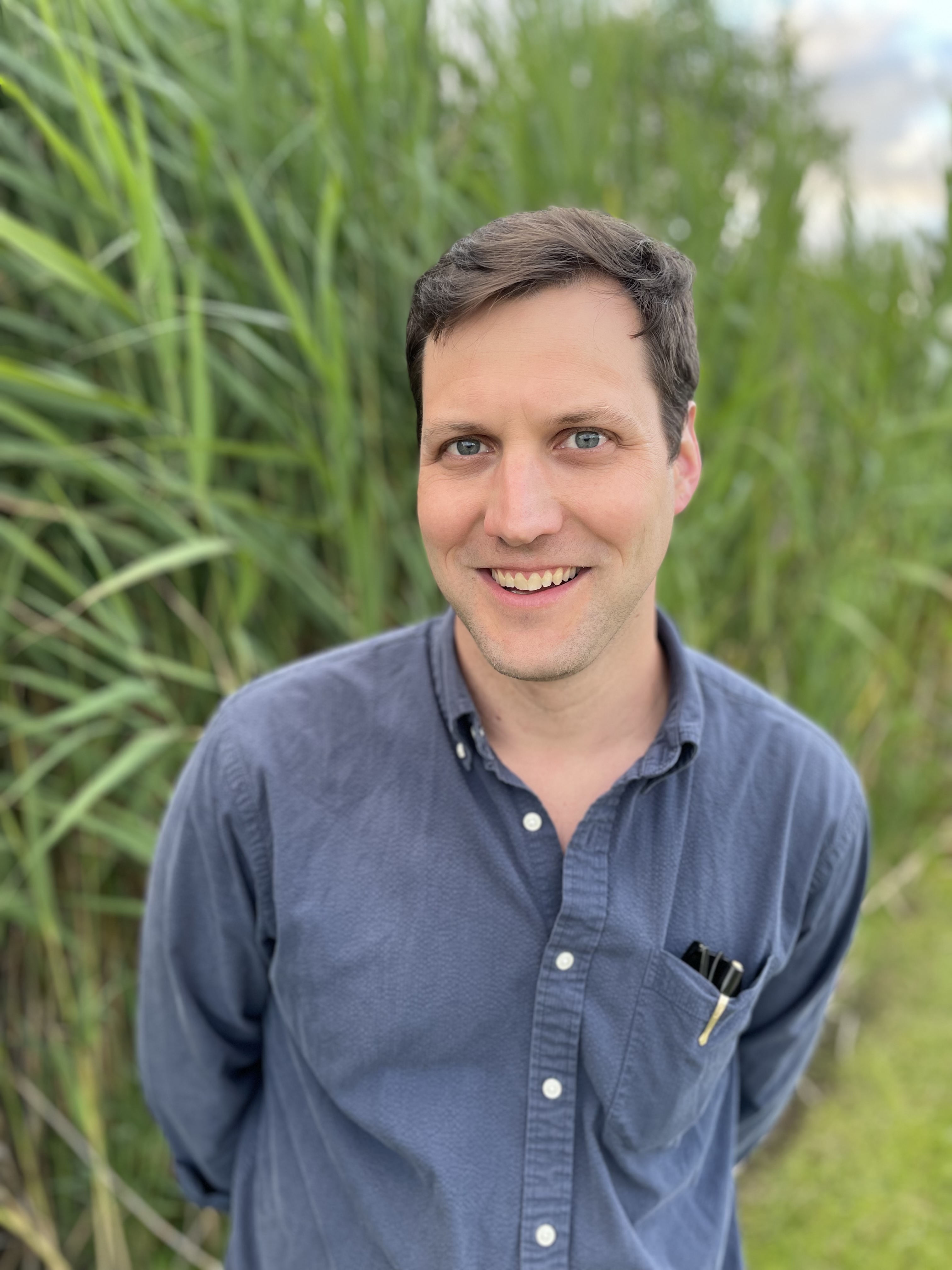
Karl Lang
Karl Lang will investigate why some minerals survive radiation damage — a discovery that could transform how we recycle and sustain the critical resources powering modern technology.
From cell phones to fighter jets, modern technology depends on critical minerals — yet extracting and processing them often harm the environment and strain supply chains. Understanding how these minerals behave at the atomic level could unlock new ways to stabilize, recycle, and sustain these resources that power our world.
School of Earth and Atmospheric Sciences Assistant Professor Karl Lang recently earned a Scialog grant to explore one of the most fundamental questions in mineral science: why some minerals withstand radiation damage without breaking down.
“Critical minerals is a buzzword right now, but what’s interesting is that many of these so-called minerals are actually rare earth elements (REEs),” explains Lang. “What we will study is how radiation can help liberate these REEs from ore minerals.”
Funding the future
Lang is one of 50 Scialog Fellows selected for the second generation of Scialog: Sustainable Minerals, Metals, and Materials, a three-year initiative designed to spark bold ideas for addressing how society acquires, uses, and recycles critical materials.
Scialog, which stands for “Science + Dialogue,” is supported by the Research Corporation for Science Advancement, the Alfred P. Sloan Foundation, and The Kavli Foundation. The program funds high-risk, high-reward projects to address scientific challenges of global significance, while supporting dialogue and community-building across fields.
“What makes Scialog exciting is that it intentionally brings together scientists from very different fields to tackle a giant, multifaceted problem,” says Lang. “It’s a fun and creative way to spark ideas that wouldn’t happen in isolation.”
Lang and the other Scialog Fellows recently met for a series of focused conversations about the challenges and gaps in current critical minerals knowledge, and by the end of the conference, they were sorted into teams to develop and propose ideas for cross-disciplinary research projects. Eighteen $60,000 grants were ultimately awarded, including one from the Kavli Foundation to Lang and his research partner, Claudia E. Avalos, from New York University. Their project, An Atomic-Level Perspective on Radiation Damage Annealing with Advanced SSNMR Spectroscopy, will investigate how minerals respond to radiation over time and how they can be stabilized or recycled — knowledge vital for sustainable resource management.
Atomic-level resilience
At Georgia Tech, Lang leads the TECHtonics Research Group, which uses radiometric dating of critical minerals to measure changes in geological Earth’s surface and lithosphere. He will team up with Avalos, a recognized expert in magnetic resonance spectroscopy, combining their talents to study the mineral monazite, an important ore for REEs commonly found in beach sands. In addition to REEs, monazite also contains high levels of uranium and thorium, radioactive elements. Despite this natural radioactivity, monazite can retain a crystal structure for millions of years. This mineral’s unique ability to resist radiation damage may help explain why it is also a valuable ore for REEs.
“You can think of mineral lattice structures like a cage, and the uranium and thorium are like exploding bombs inside,” says Lang. “Despite the explosions, the cage either doesn’t break at all or, quite possibly, heals itself. We want to understand that process at the atomic level.”
Lang hopes that understanding why certain minerals maintain their crystal structure (despite radiation damage) could inform strategies for recycling REEs, improving extraction processes, and designing materials that last longer — advancing science that could shape the future of resource management.
“We’re using a high-tech tool to study why these minerals don’t break down under radiation damage,” adds Lang. “It’s not applied research; it’s about answering a fundamental question.”